I've come to realise that mastery in communication, in the high-stakes arena of job interviews, is an art form that takes years to perfect. Yet you get to practice for it a little. The amount of time that we spent looking for jobs, is disproportionate to the amount of time we spend hired. And last week, to my surprise I flunked a lifesaving interview. This moment of truth showed me that while the force was with me, I wasn't a Jedi yet. This realisation happened through three seemingly disconnected events. First, I received candid feedback from a recruiter. The second happened during a mentorship session I led. And the third one was Ros Atkins' wisdom in his book "The Art of Explanation". These events illuminated the gaps in my interview skills, particularly in storytelling and structured response.
Last week I had an interview for a UX Lead position—a role slightly below my aspirations but with appealing compensation. My preparation was extensive, from digesting the company’s values to dissecting their nuanced product range, and poring over case studies. Confident in my readiness and backed by my solid resume, I felt more than prepared.
The interview began smoothly, with questions like:
- What can you tell us about The Company/The Product? – A straightforward query I was ready for.
- What attracted you to the job description? – Another box ticked without hesitation.
- Could you give us a brief overview of your previous roles and why you left each? – I had this covered, recounting my career journey confidently - but did I?
But then, the unexpected:
- Describe a time you helped an underperforming team member succeed.
- Talk about a product design you're most proud of, and why.
- Recall a project that didn’t pan out as expected.
I felt unprepared to give these answers, and failed to nail the level of depth and brevity required by the hiring manager. The questions, however, didn’t seem to invite the STAR (Situation, Task, Action, Result) method, or so I thought in the moment. It was a disconnect I didn’t grasp until after the interview.
First event. The recruiter’s feedback was a wake-up call. She pointed out my failure to communicate my story, something she had hinted at preparing for using the STAR method. My initial reaction was defensive, attributing the misalignment to a lack of chemistry with the impassive interviewer. However, the real issue was my underutilisation of structured storytelling.
Second Event. This realisation was cemented during a mentorship session on ADPList. While advising a mentee on interview prep, I instinctively recommended the STAR method for any question, demonstrating how it could universally apply. She chuckled at my example; a similar disconnected question turned a STAR. This advice, stemming from my recent epiphany, highlighted my oversight during my own interview.
Third Event. I've been reading Ros Atkins' "The Art of Explanation" and has since been a beacon, emphasising the importance of clear and structured explanations. The book provides a recipe for interview preparation. It gave me cues to craft responses that are both comprehensive, succinct and engaging.
Here’s a redefined approach to preparing for interviews:
- Identify Potential Questions: Look up common interview questions for your role.
- Structure Your Responses: Break down your answers using the STAR format:
• Situation: Set the scene.
• Task: Describe the challenge.
• Action: Explain your actions.
• Result: Share the outcomes.
• Reasons for Leaving: Might not be necessary, but doesn't hurt.
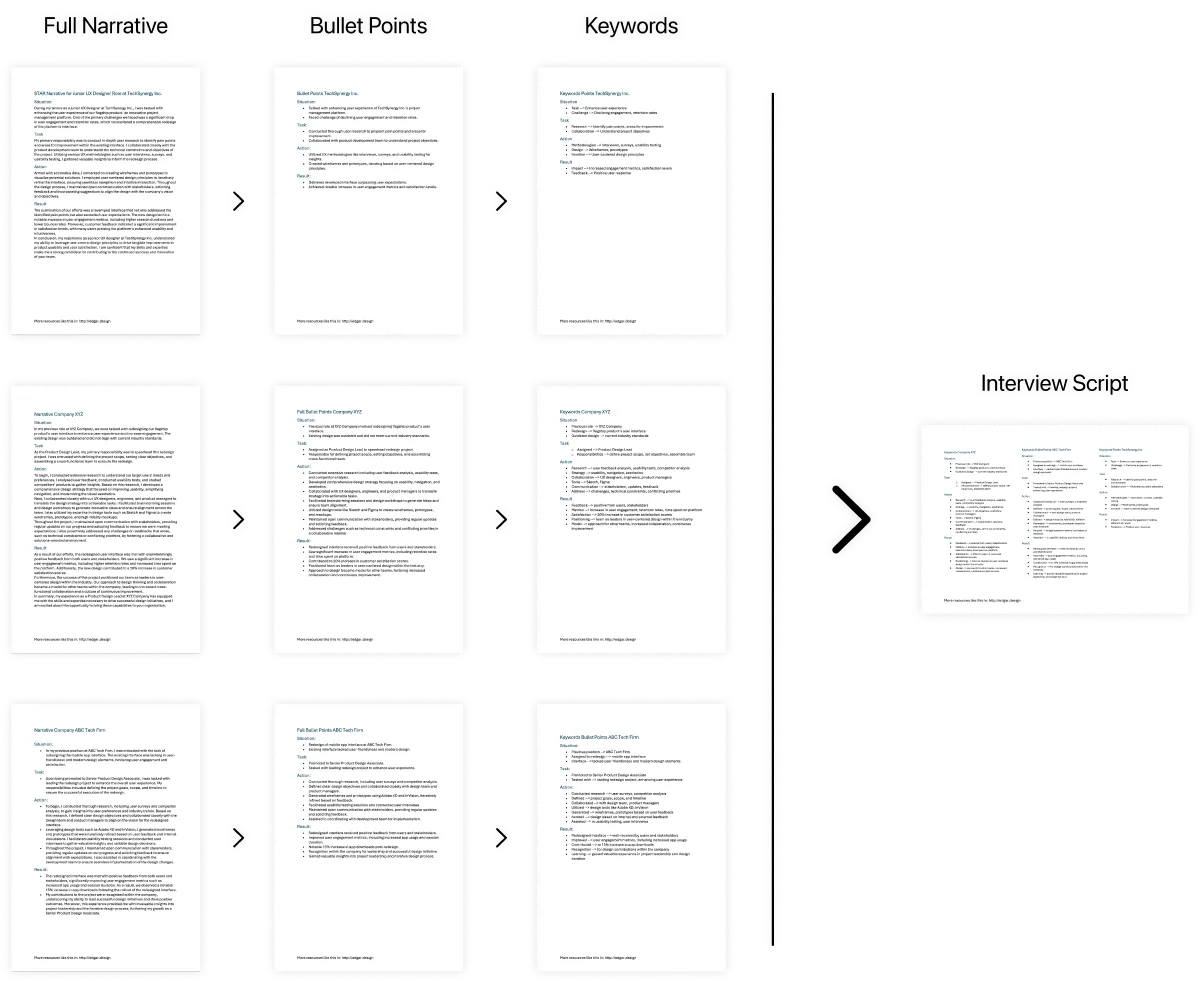
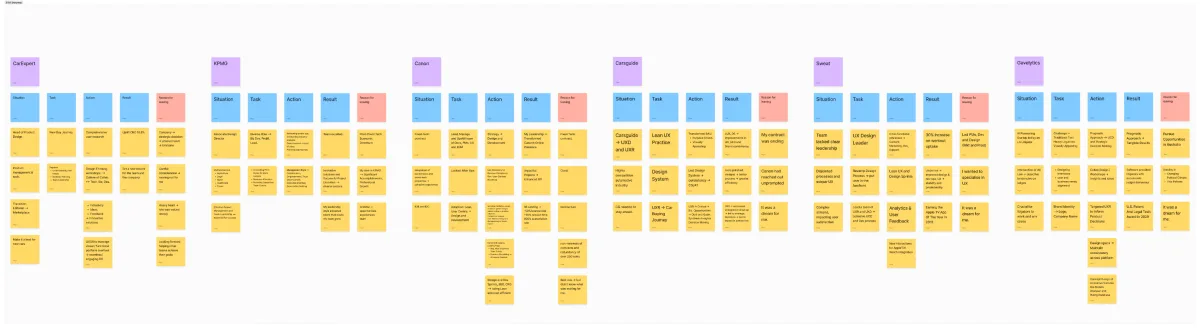
- Organise Your Narrative: Organise these points on a Figjam/Miro/Mural board or in a word doc in chronological order, creating a story map of your career akin to Jeff Patton’s method.
- Rehearse. Practice connecting the dot points for each of your questions.
Here's the word doc example:
And this is the story map example.
This episode taught me the critical importance of storytelling in interviews. It's not just about listing achievements but weaving a compelling narrative that demonstrates your problem-solving prowess and impact. As I continue to refine this skill, I share these insights, hoping to spare others the 20 year long learning curve I've encountered.
For my fellow UX designers embarking on the job hunt, remember this: mastering the art of storytelling is as crucial as your design skills. Armed with this knowledge, I believe we can all navigate the unnaturally rigid structure of interviews with grace and persuasion, turning our experiences into compelling narratives that resonate with our interviewers.